

Explore MySmileEd
Emergency!
Where to look first when a tooth gets hurt or something urgent happens.
Ask Cozy
What would you like to learn?
TRY ASKING
Browse by topic
Where to look first when a tooth gets hurt or something urgent happens.
What would you like to learn?
Smile Basics
How much toothpaste your child needs changes as they grow, and the amount matters more than most people expect. This page sets out the amount for each age, what kind of toothpaste to use, and what to do about spitting, rinsing and swallowing.
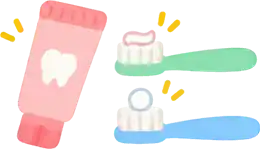
Start brushing with fluoride toothpaste as soon as the first tooth comes through. Both the American Academy of Pediatric Dentistry and the American Academy of Pediatrics say this — there is no waiting period, and no age at which fluoride toothpaste is introduced later.
The AAPD puts brushing at least twice a day with an age-appropriate amount of over-the-counter fluoride toothpaste as the first line for preventing cavities. The phrase “age-appropriate amount” is doing real work in that sentence, and the rest of this page is about what it means.
Toothpaste is not like ketchup. You only need a very small blob — a grown-up will put the right amount on for you.
A brand saying “for kids” on the tube does not tell you the amount to use. The amount depends on your child’s age, not on the packaging.

The AAPD gives two amounts, and they are the numbers to work from. The AAP describes the same two amounts in the same age bands.
No more than a smear or rice-sized amount, from the first tooth until the third birthday. The AAPD notes that keeping to this amount may reduce the risk of fluorosis. An adult should be the one putting the toothpaste on the brush at this age.
No more than a pea-sized amount. The AAP suggests teaching your child to spit at this stage, without rinsing afterwards.
Neither organisation specifies an amount above six. Ordinary over-the-counter toothpaste is what is called for; stronger prescription products exist but are for children over six at high risk of decay, and only on a dentist’s advice.
The important thing about the toothpaste itself is that it contains fluoride. Beyond that, ordinary toothpaste from a supermarket shelf is what both organisations have in mind — there is no need for anything special.

What happens at the end of brushing matters, and it is the part most often got wrong. The point of toothpaste is to leave fluoride in contact with the teeth — washing it straight out undoes some of that.
Brushing is a skill, and it takes longer to acquire than most parents expect. The AAP suggests assisting or supervising your child until they have mastered it, which it puts at around ten years of age. Until then, an adult doing it or closely watching is not overprotective — it is the recommendation.
Supervision is also what keeps the amount right. The AAPD found that supervision of brushing was one of the factors associated with fewer cavities, alongside brushing more often and using toothpaste with fluoride in it.

My child swallowed some toothpaste. Should I worry? Swallowing a small amount of the recommended quantity is not the scenario these warnings are about. The AAPD’s concern is repeated over-ingestion — toothpaste plus other fluoride sources adding up, day after day, while teeth are still forming — which is why the amounts on this page are small and why an adult should dispense them. If your child regularly swallows toothpaste, or you are unsure how much they are taking in, that is a good thing to raise at your next visit. Our page on fluoride goes into fluorosis in more detail.
Both the AAPD and the AAP recommend starting fluoride toothpaste as soon as the first tooth appears, at a smear or rice-sized amount. The amount is what keeps it appropriate for a baby. The AAPD specifically notes that keeping to no more than a smear under the age of three may reduce the risk of fluorosis.
A thin film across the bristles, roughly the size of a grain of rice — noticeably less than it feels like it should be. The AAPD publishes a side-by-side photograph of a smear next to a pea-sized amount in its fluoride therapy guidance, linked below, which is the clearest way to see the difference.
Because rinsing washes the fluoride away before it has done much. The AAPD advises that rinsing after brushing be kept to a minimum or avoided altogether, in order to maximise the benefit of the fluoride in the toothpaste. Spitting the excess out is enough.
Not for clinical reasons. What matters is that the toothpaste contains fluoride and that the amount suits your child’s age. The AAPD notes that over-the-counter toothpastes carrying the ADA seal contain between 1000 and 1500 parts per million fluoride, so an ordinary tube is doing the job. A child-marketed flavour may make brushing easier, which is a good enough reason on its own.
Later than most people assume. The AAP suggests assisting or supervising until the child has mastered the task, usually at around ten years of age. Before that, an adult should be brushing for them or watching closely — both to get the technique right and to keep the amount of toothpaste right.
Every clinical statement on this page comes from the American Academy of Pediatric Dentistry or the American Academy of Pediatrics. Where the AAPD cites the ADA for a factual detail — the fluoride concentration of over-the-counter toothpaste — that is noted in the text as the AAPD reporting it.
This website is for education only and does not replace care from your dentist, physician, or emergency services.