

Explore MySmileEd
Emergency!
Where to look first when a tooth gets hurt or something urgent happens.
Ask Cozy
What would you like to learn?
TRY ASKING
Browse by topic
Where to look first when a tooth gets hurt or something urgent happens.
What would you like to learn?
Tooth Troubles
A permanent tooth coming through behind a baby tooth that has not yet come out, giving a double row. This page explains what is happening and what a dentist may do. It does not assess your child’s teeth.
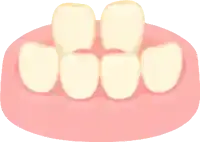
“Shark teeth” is the family name for a permanent tooth erupting behind or beside a baby tooth that is still in place. It is most often seen with the lower front teeth. The result is briefly two rows, which is where the name comes from.
The clinical term for a tooth arriving somewhere other than where it was expected is ectopic eruption, and the AAPD lists it among the things monitored as the dentition develops. A baby tooth that is still there when its successor arrives is described as over-retained.
You have two rows of teeth for a little while, like a shark. It usually sorts itself out when the baby tooth wobbles away. It is not scary and it does not mean anything is broken.
This is common and usually resolves. It is on the site because it looks dramatic to a parent seeing it for the first time, and because “usually” is not “always” — the AAPD lists ectopic eruption among the things a dentist watches for at routine examinations, which is the point at which it should be mentioned.
In short: the timing of two events has overlapped. The permanent tooth has arrived before the baby tooth in front of it has loosened and come away.
Because it usually resolves and occasionally does not, the sensible response is to mention it rather than either to worry or to ignore it.

Three things worth knowing.
Common enough to have a nickname. Seeing a second row appear is alarming the first time and is usually a timing overlap rather than a problem with the teeth.
The baby tooth in front frequently loosens and comes away on its own over the following weeks, and the permanent tooth drifts forward into the space.
Where a baby tooth does not come out, removing it may be considered. The AAPD notes that extraction of an over-retained primary tooth is used in some situations to allow the permanent tooth to come through properly. That is a decision for your dentist.
Most often, watching. The AAPD frames management of the developing dentition around monitoring at regular examinations, with intervention when there is a reason for it.

Mention it at the next routine checkup if your child is comfortable and the baby tooth is loosening. Ring sooner if the baby tooth is firm with no sign of moving, if there is pain, or if your child is bothered by it.
This page does not set a waiting period, because how long is reasonable depends on the tooth and the child. Your dentist can tell you at a glance.

Will the permanent tooth stay out of line? Often it moves forward once the baby tooth is gone, but this page cannot predict your child’s case. The AAPD notes that treatment is beneficial for many children with a developing malocclusion but is not indicated for every one — which is precisely why it is a judgement made by someone looking at the mouth. Raise it with your dentist.
Usually not, and it is still worth mentioning. The AAPD lists ectopic eruption among the conditions monitored at routine examinations. Whether this instance needs anything doing is a question for the person examining it.
Gentle wiggling of a baby tooth that is already loosening is fine. Do not force a firm tooth. If it is not moving at all, that is worth a phone call rather than persistence.
Sometimes. The AAPD describes extraction of over-retained primary teeth as used in some circumstances to allow the permanent tooth to erupt. Whether it applies here depends on the X-ray and the examination.
That is a separate question about how much room there is in the arch, and it is assessed over time rather than from a single moment. See Crowding and raise it at a checkup.
Same principle, and the same advice: mention it. The AAPD monitors eruption across the dentition rather than in one area only.
Every clinical statement on this page comes from the American Academy of Pediatric Dentistry documents below.
This website is for education only and does not replace care from your dentist, physician, or emergency services.