

Explore MySmileEd
Emergency!
Where to look first when a tooth gets hurt or something urgent happens.
Ask Cozy
What would you like to learn?
TRY ASKING
Browse by topic
Where to look first when a tooth gets hurt or something urgent happens.
What would you like to learn?
A cavity is a damaged spot on a tooth. Tiny germs eat sugar and make acid. The acid can make a tooth soft. Dentists can often find a cavity when it is small.

A cavity grows slowly. That is why your dentist checks your teeth at every visit.
What you will learn: what a cavity is, and why dentists check your teeth so often.
Try it with a grown-up: smile in a mirror and look at your teeth. At your next visit, ask your dentist, “What are you checking for?”
Everything below is written for grown-ups. It has the detail, the sources and answers to common questions.
A cavity is damage to the tooth caused by decay. The clinical name is dental caries, and the American Academy of Pediatrics describes it as one of the most common chronic childhood diseases in the United States.
The word disease is deliberate. The American Academy of Pediatric Dentistry describes early childhood caries as a chronic disease that results from an imbalance of multiple risk and protective factors over time — not a single event, and not simply a hole that appears one day. Bacteria on the tooth surface break down sugars and produce acid, and that acid gradually demineralises the tooth. The hole, when there is one, is the late stage of a process that started much earlier.
Cavities in young children used to be called “nursing bottle caries” and “baby bottle tooth decay”. The AAPD changed the name to early childhood caries because bottles are only one of several causes, and the old names pointed at the wrong thing.
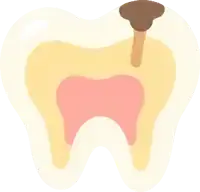
Most people picture a cavity as a visible hole. Dentists use the word earlier than that. The AAPD’s formal definition of early childhood caries counts noncavitated as well as cavitated lesions — meaning damage that has begun but has not yet broken through the surface still counts.
The earliest visible sign. The AAP describes white spots on a tooth as a sign that it is losing the calcium and minerals that keep it strong. Nothing has broken open yet.
The AAP lists tan, brown or black spots, or visible pits, as a sign that the tooth is decaying. This is the stage most people mean when they say “cavity”.
The AAPD definition includes decayed surfaces whether or not a hole has formed. A dentist recording a cavity is not necessarily describing something you could see or feel.
Partly, and it depends on the stage — which is the main reason early detection matters so much.
Enamel is not inert. The AAPD describes fluoride as working on both sides of the process: low levels of fluoride in plaque and saliva inhibit the demineralisation of sound enamel and enhance the remineralisation of enamel that has already been demineralised. That is the mechanism behind a white spot being treatable rather than inevitable.
Once decay has progressed, the picture changes. The AAPD describes caries lesions as cumulative and progressive — they build on themselves and move forward rather than resolving. At that point the question is no longer whether it will heal but how a dentist will treat it, which is covered on a separate page.

Baby teeth fall out, so it is reasonable to ask why decay in them matters. The AAPD lists the consequences of early childhood caries directly, and they are not confined to the baby teeth.
The AAPD also notes elsewhere that decay in the baby teeth is highly predictive of decay in the adult teeth. A cavity in a tooth that will fall out is still information about what is likely to happen next.
Anyone with teeth. The AAP is blunt that everyone, including babies, can get tooth decay, and that even the tiniest teeth can be affected.
Some teeth are more vulnerable than others. The AAPD notes that newly erupted teeth, because their enamel is still immature, and teeth affected by enamel hypoplasia may be at higher risk. Beyond the teeth themselves, the AAPD frames the whole thing as a balance — risk factors on one side, protective factors on the other, shifting over time. That framing is useful for parents because it means the position is not fixed.

My child has a cavity. What now? The next step is your dentist, who will look at where it is, how far it has gone, and how old your child is before recommending anything. Our page on how dentists treat cavities sets out the options they may discuss. What this page can tell you is that a cavity is common, it is a recognised disease rather than a failure of parenting, and that finding it is the point of the checkups.
Close enough in everyday use. Tooth decay is the process; a cavity is the damage it causes. The clinical term covering both is dental caries. The AAP uses “tooth decay” and “dental caries” interchangeably when writing for parents.
Visibility and symptoms do not track each other reliably, which is part of why dentists examine rather than wait for complaints. The AAPD’s definition counts damage that has not yet broken through the surface, so a lesion can be recorded before there is anything obvious to see. If your child has tooth pain, that is worth a call to your dentist regardless of what you can or cannot see.
That is a decision for your dentist, and it depends on the tooth, the child’s age and how far the decay has gone. What the AAPD does document is that early childhood caries carries consequences beyond the individual tooth — a higher risk of further decay in both the baby and adult teeth, emergency visits, treatment costs, lost school days and reduced quality of life. The question is best put to your dentist directly.
Risk genuinely varies. The AAPD points to newly erupted teeth with immature enamel and teeth with enamel hypoplasia as being at higher risk, and frames early childhood caries as an imbalance of risk and protective factors over time. That is why dentists carry out a caries-risk assessment rather than treating every child the same.
Tooth decay is described by the AAP as one of the most common chronic childhood diseases in the country, and by the AAPD as the product of multiple interacting factors — bacteria, diet, the enamel itself, fluoride exposure and time. Framing it as a single parenting failure does not match how either organisation describes it. The useful response is a conversation with your dentist about which of those factors can be shifted.
Every clinical statement on this page comes from the American Academy of Pediatric Dentistry or the American Academy of Pediatrics.
This website is for education only and does not replace care from your dentist, physician, or emergency services.