

Explore MySmileEd
Emergency!
Where to look first when a tooth gets hurt or something urgent happens.
Ask Cozy
What would you like to learn?
TRY ASKING
Browse by topic
Where to look first when a tooth gets hurt or something urgent happens.
What would you like to learn?
A pulpotomy treats the living tissue inside a tooth when decay has reached it. It is often called a “baby root canal”, which is not quite right — it treats part of the pulp and leaves the rest alive. This page explains what it is, when it is needed, what it is trying to achieve and how well it works. It does not describe the appointment, and it cannot tell you whether your child needs one.
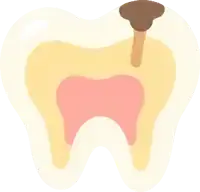
Inside every tooth is soft living tissue called the pulp. It sits in the crown — the part you can see — and continues down into the roots. When decay reaches it, the tooth cannot simply be filled, because the problem is no longer only in the hard outer structure.
A pulpotomy treats the pulp in two parts. The AAPD describes the coronal pulp — the portion in the crown — being removed, and the remaining living tissue in the roots being treated and left in place. That is the distinction worth holding on to: part of the pulp goes, part of it stays, and the part that stays is meant to stay alive.
Teeth are not solid all the way through. There is a soft part in the middle that is alive, a bit like the middle of a peach. If a sugar bug gets that far in, the dentist looks after the middle part too — not just the outside.
“Baby root canal” is the phrase families usually hear, and it causes unnecessary alarm. A root canal removes the pulp from the roots as well. A pulpotomy does not — it treats the crown portion and leaves the root tissue living. The AAPD groups it among the vital pulp therapies, and vital here means exactly what it sounds like: the tooth is still alive afterwards.
The AAPD sets out the circumstances. As always, whether they apply to a particular tooth is a question for the dentist who has examined and X-rayed it.
Those conditions are the reason a pulpotomy is not simply the next step up from a filling. It is a specific treatment for a specific situation, and a tooth that does not meet the conditions needs a different conversation.

The AAPD states the objectives plainly, and they are a useful checklist for what “it worked” actually means. Two of the three are things you would notice at home; the third is the reason your dentist may want an X-ray at a follow-up visit.
The AAPD states that the tooth’s vitality should be maintained. The living tissue left in the roots is meant to carry on doing its job until the tooth is naturally lost.
The AAPD states the root portion of the pulp should remain free of symptoms, with no adverse clinical signs afterwards such as sensitivity, pain or swelling. Any of those appearing later is a reason to contact your dentist.
The AAPD includes the absence of adverse changes visible on an X-ray afterwards among the objectives. This is the part that cannot be checked at home, and it is why follow-up matters.
Two things follow the treatment itself: a material placed over the living tissue that stays, and a restoration sealing the whole tooth.

Well, on the evidence the AAPD reviewed, though not perfectly. Its guideline reports an overall success rate at twenty-four months of 82.6 per cent across all the medicaments studied. The two it recommends most strongly did better than that average: MTA at 89.6 per cent and formocresol at 85.0 per cent, with no significant difference between them.
Two things are worth reading alongside those figures. The AAPD notes it was unable to recommend one type of vital pulp therapy over another, because studies comparing them directly have not been done. And it reports high success rates across all three of those therapies, recommending that the choice be made on a biological basis, on clinical expertise, and on patient preferences — which includes yours.

My child needs a pulpotomy and I want to understand it. Ask what was seen on the X-ray, which material they plan to use, what restoration will go on top, and what the follow-up looks like. If you have heard it called a baby root canal and that is what is worrying you, say so — the difference is real and worth having explained. There is a list of questions to ask a dentist in the For Parents section. Nothing here is a second opinion, and none of it is based on your child’s teeth.
No, and the difference matters. The AAPD treats them as separate procedures. A pulpotomy removes the pulp from the crown of the tooth and leaves the living tissue in the roots in place — which is why it sits among what the AAPD calls the vital pulp therapies. A pulpectomy, the procedure closer to what people mean by a root canal, deals with the root canals as well. Which one a tooth needs depends on the state of the pulp, and that is your dentist’s assessment to make.
Because sealing the tooth is part of the treatment working. The AAPD states that the final restoration should completely seal the involved dentin from the oral environment. Its restorative guidance separately reports that outcomes for primary teeth that have had pulp therapy are best in teeth restored with a stainless steel crown, and lists following a pulpotomy among the situations in which crowns are indicated. There is more on Crowns.
A medicament is placed over the living tissue that remains in the roots. The AAPD’s guideline panel recommends mineral trioxide aggregate (MTA) and formocresol most strongly, on moderate-quality evidence, and recommends ferric sulfate, lasers, sodium hypochlorite and tricalcium silicate conditionally on weaker evidence. It recommends against calcium hydroxide for this purpose. If you have a question or a concern about a particular material, ask which one your dentist intends to use and why — that is a reasonable thing to want to know before the appointment.
The AAPD reports an overall success rate at twenty-four months of 82.6 per cent across the medicaments studied, with MTA at 89.6 per cent and formocresol at 85.0 per cent. Those are figures from the research it reviewed rather than a prediction about one child’s tooth. The AAPD also notes it could not recommend one vital pulp therapy over another, because the direct comparisons have not been studied.
That is a decision for your dentist, and it turns partly on how long the tooth still has to do its job. The AAPD’s pulp therapy guidance is written for primary teeth throughout rather than treating them as a lesser case. Where a tooth cannot be kept, Baby tooth extractions covers what follows. There is more on why decay in baby teeth is taken seriously on What is a cavity?
Every clinical statement on this page comes from the American Academy of Pediatric Dentistry documents below. The success rates come from the guideline on vital pulp therapies, which grades the strength of the evidence behind each recommendation.
This website is for education only and does not replace care from your dentist, physician, or emergency services.