

Explore MySmileEd
Emergency!
Where to look first when a tooth gets hurt or something urgent happens.
Ask Cozy
What would you like to learn?
TRY ASKING
Browse by topic
Where to look first when a tooth gets hurt or something urgent happens.
What would you like to learn?
Emergency!
An adult tooth has come out of its socket completely. This page explains what has happened and what a dentist may do. What you do in the first few minutes matters, so follow the steps below and contact your dentist or your local emergency services now.
Call a dentist now. This is urgent. Call 911 first if your child is unconscious or cannot be woken, is breathing in an unusual way, or has a seizure. Go to an emergency department if your child also passed out, vomited two or more times, or has a bad headache, dizziness, confusion, or trouble walking or speaking.
Is it a baby tooth or an adult tooth? Never put a baby tooth back in. Adult teeth are usually larger and more yellow-white, and the child is usually 6 or older. If you are not sure, treat it as an adult tooth and call the dentist while you act.
Time matters. An adult tooth has the best chance when it is back in its socket within about 15 minutes.
Please avoid these things:
A permanent tooth has been displaced entirely from its socket. Unlike a baby tooth, an adult tooth is not replaced by another one, so this is treated as an urgent situation rather than something to raise at the next appointment.
If the tooth cannot be found, say so when you call. The AAPD states that when a tooth or fragment remains unaccounted for, radiographs are required to rule out its having been breathed in or coming to rest in the surrounding tissues — which is why an unfound tooth is itself a reason to be seen.
The AAPD lists reimplantation — putting the tooth back — among the surgical interventions that may be required for dental trauma, alongside stabilisation or splinting, and, where a tooth cannot be saved, extraction and later replacement. Which applies depends on the tooth and on what has happened to it, and that is an assessment only the dentist in front of your child can make.
The AAPD notes that complex cases may involve consultation with or referral to an endodontist, orthodontist, oral and maxillofacial surgeon, periodontist or prosthodontist, and it points to the International Association of Dental Traumatology guidelines for managing dental injuries.
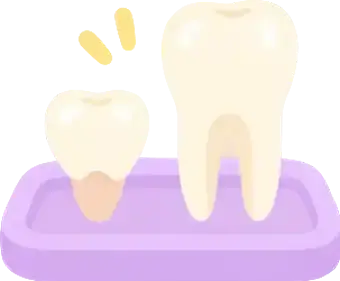
If a big tooth has come out, a grown-up will ring the dentist straight away. That is the right thing to do and it is not your fault. The dentist will look after it.
Will the tooth go back in? Often it can, and the sooner it goes back in, the better the chance. Whether it can stay in is a decision for your dentist, who will check the tooth and the injury. Call now rather than reading on, and take the tooth with you if you have it.
Treat it as one. A permanent tooth has no replacement coming, and the AAPD groups traumatic injuries among the conditions requiring both acute and ongoing management to prevent negative consequences. Contact your dentist or your local emergency services now. This page cannot tell you how urgent your particular situation is.
Yes, and it is worth saying when you call. The AAPD states that when a tooth or fragment remains unaccounted for, radiographs are required to rule out aspiration or the tooth being lodged in surrounding tissue — for example embedded in a lip laceration. A missing tooth is a reason to be seen, not a reason to wait.
The situation is handled differently. See Knocked-out baby tooth. If you are not certain which it is, that in itself is a reason to contact your dentist rather than to work it out at home.
The step-by-step guidance above follows the International Association of Dental Traumatology (IADT) guidance on a knocked-out permanent tooth, reprinted in the AAPD Reference Manual, and the American Academy of Pediatrics (AAP) HealthyChildren pages below. The 911 and emergency department wording follows the AAP head-injury page. Review status: pending. No named reviewer or review date yet.
This website is for education only and does not replace care from your dentist, physician, or emergency services.