

Explore MySmileEd
Emergency!
Where to look first when a tooth gets hurt or something urgent happens.
Ask Cozy
What would you like to learn?
TRY ASKING
Browse by topic
Where to look first when a tooth gets hurt or something urgent happens.
What would you like to learn?
Emergency!
A tooth has been driven up into the gum so that less of it shows, or none of it does. This page explains what to do first, what not to do, and what a dentist may do.
Call your dentist today. A tooth pushed into the gum needs to be checked soon, and an X-ray is usually needed. Call 911 first if your child is unconscious or cannot be woken, is breathing in an unusual way, or has a seizure. Go to an emergency department if your child also passed out, vomited two or more times, or has a bad headache, dizziness, confusion, or trouble walking or speaking, or if you think the jaw may be broken.
Stay calm and check your child. Look for other injuries too, especially to the head, lips and gums.
Please avoid these things:
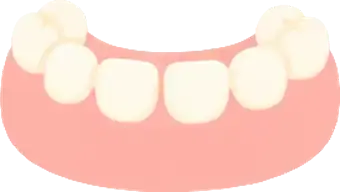
An impact has pushed the tooth further into the bone rather than out of it. The tooth may look shorter than its neighbours, or may not be visible at all — which sometimes leads families to believe it has been knocked out and lost.
That confusion matters. If a tooth appears to be missing and has not been found, the AAPD states that radiographs are required to rule out aspiration or the tooth lying within surrounding tissue. A tooth driven into the gum will be found on that X-ray. Either way the answer is the same: contact your dentist.
Assessment normally starts with an examination and X-rays, because the position of the tooth, and in a young child the adult tooth developing above it, cannot be judged by looking.
Baby teeth. The International Association of Dental Traumatology (IADT) guidelines say a pushed-in baby tooth should usually be allowed to come back down on its own. This often happens within about six months, but can take up to a year. The IADT recommends a quick referral, within a couple of days, to a dental team experienced with young children, and follow-up visits to watch the tooth and the adult tooth underneath.
Adult (permanent) teeth. For an adult tooth, the IADT guidelines describe several options depending on how far the tooth was pushed in and how developed its root is. The dentist may wait for it to come back down on its own, or move it back into place and hold it with a flexible splint. The nerve inside the tooth often needs treatment, so follow-up visits continue for several years.

Your tooth got pushed up instead of falling out. It is still there, even if you cannot see much of it. The dentist has a special picture that shows exactly where it is.
The tooth seems to have gone — is it lost? Not necessarily. A tooth driven into the gum can look missing. Say exactly that when you ring: that the tooth cannot be seen and has not been found. The AAPD states an unaccounted tooth requires radiographs to rule out its being inhaled or lodged in tissue, so this is a reason to be seen either way.
For a baby tooth, often yes. The IADT guidelines say most pushed-in baby teeth come back down on their own within about six months, sometimes up to a year. For an adult tooth, it depends on how far it was pushed in and how developed the root is. The dentist may wait and watch, or move it back into place. Either way, your child needs to be seen so the dentist can take X-rays and plan follow-up.
Often you cannot tell from looking, which is exactly why the assessment includes radiographs. If a tooth cannot be seen and cannot be found, treat it as needing to be checked rather than assuming it is lost.
It is possible, and it is one of the main things the dentist checks. The root of a baby tooth sits close to the adult tooth developing above it, and the IADT notes that pushed-in and knocked-out baby teeth are the injuries most often linked to later problems with the adult tooth. The dentist will explain what to watch for and may suggest follow-up visits, sometimes until the adult tooth comes in.
The first-aid steps follow the American Academy of Pediatrics (AAP) HealthyChildren guidance on dental emergencies and the International Association of Dental Traumatology (IADT) 2020 guidelines for permanent and primary teeth, reprinted in the AAPD Reference Manual. The 911 and emergency department wording follows the AAP head-injury page. The tips not to pull the tooth down and not to skip the visit are general safety wording based on these sources.
Review status: pending. No named reviewer or review date yet.
This website is for education only and does not replace care from your dentist, physician, or emergency services.